
The genetic history of South America’s Afro-American populations: the emblematic case of the “Noirs Marrons” [Maroons, descendants of runaway slaves from Africa] in French Guiana and Suriname
Several historical sources attest that between 1526 and 1875 approximately seven million Africans were displaced to South America as slaves. Archive data indicate that the ports from which the ships transporting the captives set sail for the plateau of the Guianas and what is now Brazil and Columbia were located on the Bight of Benin, encompassing the coasts of what are now Ghana, Togo, Benin, and Nigeria. A considerable number of slaves in Guiana managed to escape captivity and formed clandestine, organized communities, known collectively as the Businenge (“people of the forest”) or Noirs Marrons (maroons or runaway slaves), who continued to live is relative isolation in forests across French Guiana and Suriname. While we have documents indicating the ports they left from, we still do not know with certainty which countries they came from within Africa and the degree to which the slaves and their descendants mixed with the surrounding populations.
The authors of this study took available data on the genetic diversity and extension of Bantu-speaking groups in West Africa and carried out a series of analyses to identify the genomic characteristics of the ancestors of the Noirs Marrons. Analysis of over 4.3 million genetic markers in their DNA—in this case, through SNP or Single Nucleotide Polymorphism analysis—enabled them to determine the genetic profiles of three African-American groups and a considerable number of West African groups, and to compare those profiles with the genomic database on the populations of continental Africa, Europe, America and eastern Asia (The 1000 Genomes Project Consortium 2015).
Of the three South American groups originally from Africa, the Noirs Marrons show the highest level of African ancestry: 97%, or nearly their entire genome. Theirs is the most heavily African ancestry, maintained on the American continent over more than four centuries. Afro-Brazilians show more of a genetic mix, including 23% European ancestry, as do Afro-Columbians, with 11% European and 13% American ancestries.
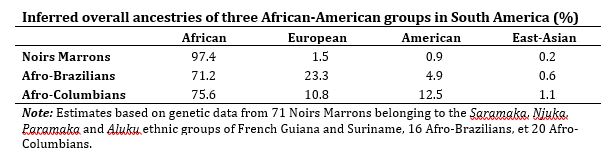
To characterize in greater detail the African origins of these three groups, their main components were studied using Principle Components Analysis (PCA). This led to finding that Noirs Marrons and Afro-Columbians are genetically close to current inhabitants of Ghana, Benin and ethnic groups in western Nigeria, while the genetic makeup of Afro-Brazilians is close to that of Bantu-speaking groups of Cameroon, Gabon, and Angola.
In addition to improving our knowledge of the African origins of the Noirs Marrons of French Guiana and Suriname, this study shows how genetic marker analysis can contribute to history and to our knowledge of ancient human migrations.
Source: Fortes-Lima C., Gessain A., Ruiz-Linares A., Bortolini M.C., Migot-Nabias F., Bellis G.*, Moreno-Mayar J.V., Restrepo B.N., Rojas W., Avendaño-Tamayo E., Bodoya G., Orlando L., Salas A., Helgason A., Gilbert M.T.P., Sikora M., Schroeder H., Dugoujon J.M., 2017, “Genome-wide ancestry and demographic history of African-descendant Maroon communities from French Guiana and Suriname”, American Journal of Human Genetics 101, pp. 725-736.
Further reading: The 1000 Genomes Project Consortium, 2015, “A global reference for human genetic variation”, Nature 526, pp. 68-74.
Contact: Gil Bellis
Online: June 2020