
Manuel de Paléodémographie
Abstract
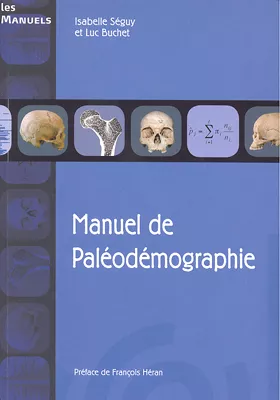
Paleodemography is the study of past populations who left few – or no – written records. Based on archaeological data, it aims to reconstitute the dynamics of human settlement or to estimate certain demographic parameters by studying vestiges such as exhumed skeletons, for example.
This approach is the focus of the present book. This manual is the fruit of collaboration between historical demographers and anthropological archaeologists who, with the help of mathematicians and statisticians, have developed methods for linking osteo-archaeological data with historical and environmental sources to shed light on ancient populations. An endeavour of this kind involves a multidisciplinary team, but also relies upon high-quality sources available in sufficient numbers.
It is a practical manual for anthropologists and archaeologists wishing to interpret ancient bones in demographic terms, written in readily understandable terms for all those wishing to comprehend and apply the described methods. Data linkage provides a means to retrace the living conditions of past populations in relation to the socioeconomic, technical, cultural and health contexts of their environment, opening up an important historical dimension to the discipline and offering new research perspectives.