
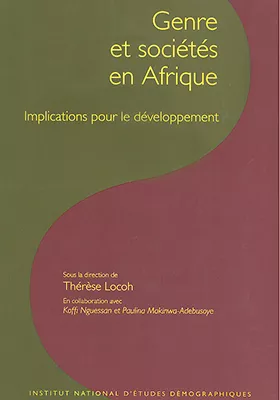
Genre et sociétés en Afrique
Abstract
Beyond the biological differences characterizing each sex, the inequalities of status between men and women and the relations between them are a social construct expressed by the concept of “gender“. Each society
structures its own gender system, i.e. a set of selective norms, beliefs and truths that guide the behaviour of men and women, impose gender roles, and encourage certain attitudes while condemning others.
The question of development in the South has gradually moved on from a bleak depiction of « the condition of women » to an approach which places the dynamics of gender relations at the centre of the debate. Understanding these dynamics and their impact on the process of change, and finding ways to strengthen women’s empowerment are strategic d evelopment priorities.
In Africa, very few research programmes and project assessments are gender-sensitive. Much progress is yet to be accomplished in this area. This book gives an overview of knowledge on gender relations as expressed through the history of societies, institutions and economic activity, and through attitudes to health, marriage and family formation. For the first time, issues such as child health inequalities and nuptiality are covered for the whole of Africa. Though demography and statistics occupy a central place, a range of qualitative approaches and the contributions of historians, economists and sociologists offer a multidisciplinary perspective on gender issues in African society.