
The circulation of Euro coins, in 2002
Reading the graph
This map shows the distribution of euro coins minted outside
France. The colours correspond to the proportion of foreign euros
in circulation, going from light for the lowest proportions (5%) to
dark for the highest (70%). Areas shaded in the same colour
correspond to zones with the same proportion of foreign euro coins.
The graph is based on data from quarterly surveys of 2,000 people
whose loose change was examined to measure the country of origin
and face value of their euro coins.
To construct the map, the information gathered at each sampling
point was replaced by an average of the results obtained in
neighbouring points, giving higher weights to the closest ones and
lower weights to those further away. The information at each point
is thus replaced by an image of overall distribution.
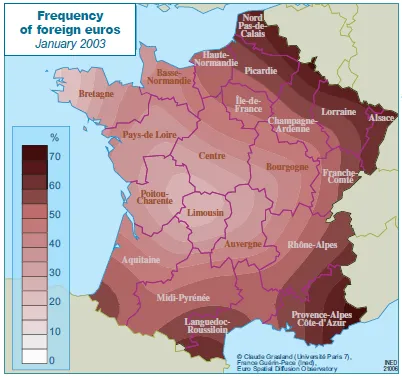
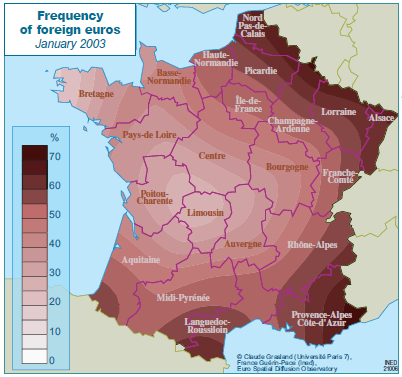
Foreign euros are less common in Brittany and in central France
The euro was introduced in January 2002. Each country mints its own identifiable coins, but they are legal tender throughout the euro zone. They thus serve as a marker of human movements, travelling in small quantities in the pockets and purses of their users. French people who travel to another euro-zone country take away French euros and bring back foreign ones, and foreigners visiting or passing through France do likewise. The foreign euros brought into France then circulate from person to person. The frequency of foreign euro coins thus indicates the frequency of movements to or from other euro-zone countries.
In January 2003, one year after euro coins were introduced, 11% of the 19,000 coins observed were foreign, and half of all respondents had at least one foreign euro coin in their loose change. The Limousin region and the western part of Brittany are the most isolated zones, while foreign euros are most common along the borders and main travel routes. The most frequently observed coins are from Spain, Germany and Belgium, and the 1 and 2 euro coins are more mobile than those with smaller face values.
« Mobilité européenne, tourisme et diffusion des pièces euros étrangères en France » (C. Grasland, F. Guérin-Pace, Revue d'Economie régionale et Urbaine, 2004, n°5, pp 793-822.)
« La diffusion spatiale des pièces euro en Belgique et en France » (S. Berroir, C. Grasland, F. Guérin-Pace, Revue belge de Géographie (Belgeo), 2005, n°4, pp. 345-358.)